
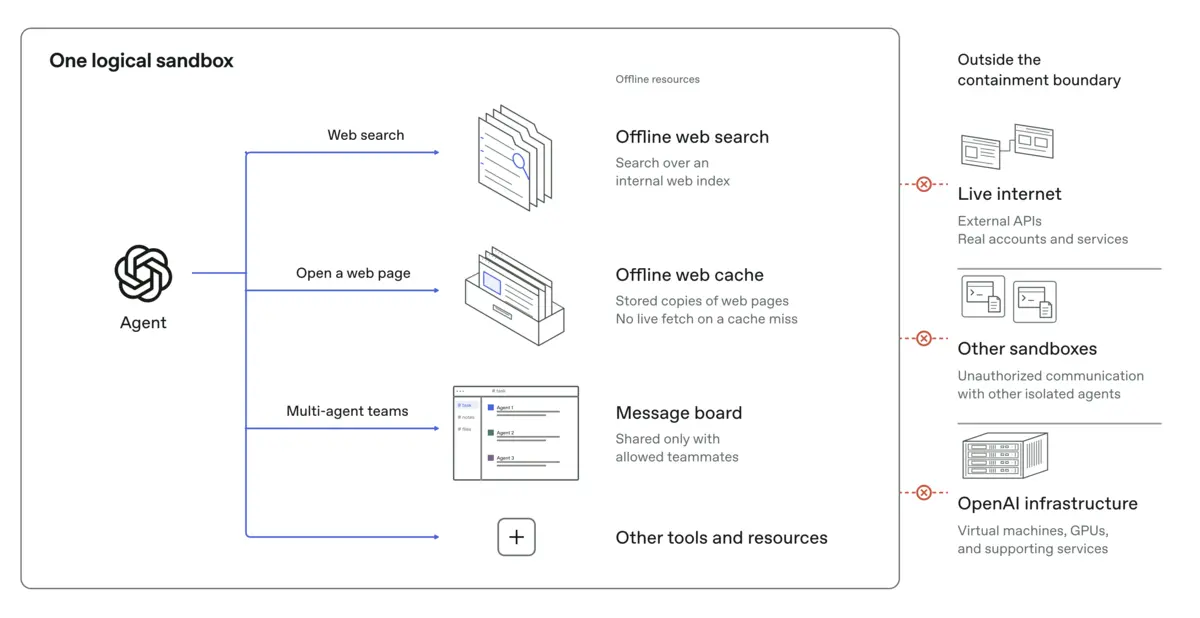
Security publication: On October 23, OpenAI described how it has further secured the internal environments used to train and evaluate frontier models. These research environments are explicitly different from those in which customers use released models. For its most powerful training runs, OpenAI blocks live internet access and instead provides models with an internal search index and stored web content.
The security architecture uses overlapping layers: restricted containers inside lightweight virtual machines, monitoring for unauthorized behaviour, and network and cloud boundaries designed to hold if an earlier layer fails. During targeted red-teaming, teams of AI agents looked for ways to reach the internet, cross other security boundaries or communicate between isolated tasks. OpenAI reports that this uncovered and remediated previously unknown software vulnerabilities and configuration errors. This describes internal security architecture; it is not a new customer feature or a notice that ordinary ChatGPT environments were affected by these flaws.
DigiDare perspective: an SME does not need to reproduce this scale, but it can apply the same principle to its own AI agents. Grant access only to the data, accounts and actions required for one task, separate testing from production, and block outbound network traffic when it is not needed. Run code in an isolated environment, log actions, and provide an automatic stop plus human approval for risky steps. Then periodically test whether the agent can still move beyond its permitted boundary through inputs, plugins or configuration errors.
What does this mean for your business? ↗